
By: Jeff Peckham
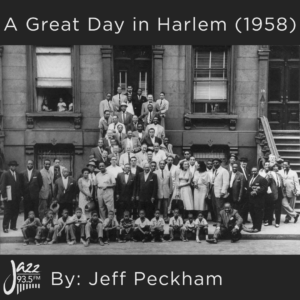 On August 12, 1958, a 27-year-old Sonny Rollins eagerly answered a morning call to gather outside an East 126th Street brownstone for a freelance Esquire magazine photo shoot. Having grown up in central Harlem surrounded by his musical idols, the acclaimed tenor saxophonist jumped at the chance to stand alongside his contemporaries in what freelance photographer Art Kane captured as “A Great Day in Harlem”. While other musicians doubted whether jazz artists would show up for a 10 a.m. call time, Rollins considered it a joyous social reunion. He later reflected that the iconic photograph powerfully humanized jazz artists and offered a rare sense of profound professional respect during an era of pervasive segregation and racism.
Photographing 57 chaotic jazz legends at 10:00 a.m. was an exercise in pure improvisation, as 33-year-old art director Art Kane had never taken a professional photograph before and possessed no studio. He chose a brownstone at 17 East 126th Street and convinced the police to temporarily block off local traffic. Because there was no formal RSVP system, Kane had no idea who would show up until the musicians began pouring onto the sidewalk. Once they arrived, the shoot quickly devolved into a chaotic, joyous family reunion. Kane managed to wrangler the legends using a combination of unorthodox tactics and sheer patience:
The Newspaper Megaphone: Lacking proper audio equipment, Kane rolled up a copy of the New York Times to use as a makeshift megaphone. He stood across the street, screaming through the paper cylinder to beg the musicians to move into a single, cohesive formation.
Ignoring the “No Kid” Rule: Editors from Esquire initially instructed Kane to clear the neighborhood children out of the shot. Kane flatly refused, believing the kids anchored the frame’s neighborhood poetry. He allowed a line of local children to sit directly on the curb next to an exhausted Count Basie.
Embracing the Distractions: Kane spent over an hour fighting countless interruptions, including passing horse-and-buggies, street peddlers, and Milt Hinton’s wife filming home movies from across the street. Rather than demanding rigid compliance, Kane kept shooting through the chaos with a borrowed Hasselblad camera.
The Infinite Chat Loop: The musicians had not seen each other in months, causing them to constantly drift out of the frame to talk, laugh, and catch up. In fact, stride pianist Willie “The Lion” Smith grew so tired of waiting for the crowd to assemble that he sat down on a nearby staircase and missed the famous frame entirely. Ultimately, Kane captured one rare frame where nearly everyone looked at his lens simultaneously, except for Roy Eldridge, who was being playfully teased by a smirking Dizzy Gillespie.